Did my first training ride with the Seattle International Randonneurs. Officially this was the second ride since the first one got canceled due to a snow storm. The weather was good with temps in the 30's and no rain. We met in a parking lot in Tukwila and after signing in I realized I'd forgotten a critical piece of kit: my helmet! Fortunately, REI was right across the street so I dashed over and picked up the cheapest Bell I could find. Peter Beeson gave a rundown of basic safety and a welcome speech. There was a pretty good crowd, probably 40-50 riders.
I hadn't bothered to make a map of the route beforehand and since this was a training ride in January I naturally assumed it would be what most people do for a January training ride: flat and in a low gear with no loads on the knees. Little did I know the SIR definition of a January training ride is "Let's cram in as many knee shattering climbs as we can!" There was one climb that had several riders - myself included - getting off and walking. Doing this sort of climbing so early in the season when termperatures are in the 30's borders on stupidity. Of coruse for every climb there is also a descent and some of these descents were pretty twisty and proved to be a great testing ground for my new Paul Racer brakes. About halfway up the climb on Northpoint road I came to my senses and eased off trying to put as little strain as possible on my knees. I wound up riding the rest of the ride solo though apparently a few other riders crawled in after I finished. The route itself was scenic and challenging and would be a great ride to do later in the season but as a January training ride it was a bit too much.
From here on out I plan to map out all the training rides in Topo to avoid any such surprises. At the end Peter did put my fears to rest by pointing out that there is nothing on PBP as tough as the climbs we did on this ride.
Sunday, January 21, 2007


Monday, January 08, 2007
Baby steps to Paris
I'm planning to do Paris-Brest-Paris this summer and I have admit my training has been a little less than disciplined so far. Between a new baby and an old house I haven't been on the bike much in recent months. Now that we're into 2007 and the event is less than 9 months away I've decided to buckle down and actually start training. The Seattle International Randonneurs start their training rides next week and I plan to start attending those. Also dedicating myself to spending some time on the trainer every night. Not the same as actually riding on the road but my current job lacks the facilities to enable bike commuting and riding at night in the rain probably isn't the safest thing for a new father to do. When (if?) the weather dries up I'll start logging some actual road miles at night.
Wednesday, December 27, 2006
Mainstream niche?
I've been looking through some 2007 catalogs and it seems if there's a new trend to be had it has to be the growing number of niche bikes being offered by mainstreram companies. More and more companies seem to be finding room for such oddball categories as single speed cross bike, fixed gear road bikes (not track bikes), fully loaded commuter bikes, and other breeds that previously one had to go to a resourceful mechanic or custom frame builder to acquire.
Some brands have always been known for flying their freak flags. I mean seriously, if you were actually surprised that Bianchi produced a single speed cyclocross bike then you clearly haven't been paying much attention to the industry. On the other hand you have mainstream companies like Raleigh making a nice fixed gear road bike and 29" single speed MTB, Schwinn making electric bikes, and Trek making a high-end commuter bike. I have to wonder what is driving such bikes. Is it that people are tired of yet another carbon fiber road bike or dual suspension MTB? Is it because today's avid cyclists are not as mechanically competent as cyclists of previous generations and therefore can't cobble together such Frankenbikes on their own? Or is it simply a way for brands to try and distinguish themselves in an era where so many bikes seem to be generically plucked from the Big Book O' Asian Bike Parts?
Sales of such bikes do seem to be doing well. I've chatted with a few people in the business about some of their more niche models and was surprised to hear things like "amazing sales" in the same sentence as "29" MTB. This is a refreshing change from 10 years ago when I remember such daring bikes as the Bridgetone XO-1 and Bianchi Project series dying on the vine in stores.
Finally, amidst all of this you have Redline. Redline has long been a company that only built niche bikes starting with the now ubiquitous cyclocross bike and later extending to include the 925 fixed gear bike and a series of single speed MTBs in both 26" and 29" flavors. So what new niches are they going into? Road bikes and hybrids! When everyone else starts going niche they start going mainstream. Gotta love it!
Tuesday, December 19, 2006
A modern Herse for the common man?
I've been thinking about a new bike recently. Specifically, I've been thinking about the Kogswell P/R. The P/R is an inexpensive, TIG welded, steel frame/fork with geometry borrowed from the Herse frames of yore. It retails for $540 and that includes fenders. It also is designed around 650b wheels. It's a go anywhere and carry anything kind of bike.
That said, it's a pretty hefty frame. Bikes built up typically weigh 25 pounds or more. Now I'm hardly a gram counter but at the same time I have to squawk at that kind of weight. Don't try to tell me weight doesn't count. Anyone who says this probably hasn't had the pleasure of riding a nice, light bike. Most of the people who claim weight doesn't matter tend to be steel riding luddites and hearing them say weight doesn't matter is pretty hard to buy into. I guess ignorance is bliss.
The reality is there's no reason you can't build a reasonably durable (5-10 year lifespan for an average, active rider) bike with generator lights, fenders, and rack that weighs under 20 pounds. 50 years ago Herse and Singer made bikes that weighed less than this. Of course their bikes featured extensively modified components and cost a fortune. Modern builders have a few advantages. For starters we now have different materials such as composites, stronger aluminum alloys, titanium, and stronger steel alloys. Using mostly stock parts from Shimano, Campagnolo, Ritchey, and FSA one should have no problem getting a bike down under 20 pounds.
Starting with the frame the first thing I'd change is the tubing. Titanium would be the best choice as it's durable, comfortable, and light. However it's not cheap and is a real chore to work with. If cost were no object this would be the material of choice. My choice of material would be Easton Ultralite. It's been around for many years so its durability and traits are well established, it's easy to work with, and it's not very expensive. As for ride quality, it's not oversized to the degree of a Cannondale or Klein and aluminum is more flexible than steel. In real world terms, my Easton Ultralite cross bike is probably a tad more comfortable than my SOMA Smoothie ES made from Reynolds steel. Why not simply make it from a lighter steel tubeset? Well you could and it would be a great frame. However it would likely cost more than an alloy frame and I'm not sure if an ultralight steel is really anymore durable than a midweight aluminum. One of the goals here is to achieve the functionality and weight of the bikes used in the technical trials while taking advantage of modern manufacturing technology. With that objective in mind, doing the bike in steel would be a challenge.
Geometry is a no-brainer: copy the Kogswell P/R. The P/R is an incredibly well executed bike based on the works of Herse and Singer. Of course with a frame made from lighter steel or alloy the bike wouldn't really be a P/R - more likely just the R part. Of course the R part in this case could stand for "randonneur", "racy", or "rain bike". In a nutshell, it would be a zippier version of the P/R. A perfect bike for:
1) Timed randonneur events.
2) Commuters who want a bike with some zip and don't want a high BB cyclocross bike.
3) Road racers wanting a rain bike.
4) Go fast credit card tourers.
5) Century riders.
Now I just have to find someone to make it! Sadly, I don't have $20,000 to spare.
Thursday, November 02, 2006
Ostrich Bag, Velo Orange decaleur and Nashbar front rack
I've been wanting a large front bag for a long time. They make great sense for long day rides where you want to have a shell, food, camera, map all handy so you don't have to stop. Problem is they tended to be very expensive and very hard to come by. For the longest time your only real choice was the Berthoud bags. While very nice they tend to be extremely expensive with a bag, rack, and decaleur combination easily topping $425.00!! People try to justify this price by claiming they're durable. I'm sure they are durable but let's keep in mind this is a handlebar bag on a touring bike - not a backpack being dragged through the muck by a Navy SEAL (whose bags incidentally cost less than a Berthoud even though they see far more abuse!!)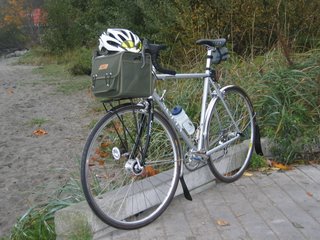
Fortunately for big bag fans the unlikely combination of Velo Orange and Bike Nashbar have come to the rescue! For less than $175 you can have a system with all the functionality of the Berthoud set-up that will work on almost any bike (unlike the Berthoud system!)
Let's start with the bag. It's a nice olive color, canvas, and generally looks like something from an Army surplus store. It's a good size though I find it too small for commuting. It'll carry my clothes but not a pair of shoes. For day riding it's plenty large. I took mine out on one of those sketchy Seattle days where the skies look like they could open up at any moment. My bag easily handled my camera, rain pants, rain jacket, cap, gloves, and food. You can see the size of the bag compared to my helmet.

Inside the main compartment has a pair of flaps with an elastic cord to help keep the elements at bay during light rain. For heavier rain you'll need a rain cover (not included). The rear compartments are capable of holding 3 Clif bars each. They're ideal for storing food since they're easily reached. The front flat pocket is useful for small, flat items and the side pockets are a handy place to stash gloves, warmers or glasses. The flap covering the main compartment is secure with 2 elastic cords in the front. I first wondered about how hard this would be to open while riding. While it does require a reach is easier than fusing with the zippers on most bags and quite a bit easier than the old style buckles on the Berthoud and Carradice bags. It's also a very light and fool proof way to secure a bag.
The decaleur is a robust and shiny unit. I didn't place items on the scale but it wouldn't surprise me if the decaleur weighed more than the rack. It could probably be made from lighter tubing and Bicycle Quarterly reports the Velo Orange is doing just that. Weight aside, it's an elegant and simple device. I would strongly suggest gently bending the tubes that the prongs slide into so as to create a tighter fit. Once I did this I have no problems with the bag rattling or bouncing loose even when going over speed bumps.
The rack is a very generic welded alloy rod affair. Millions like them have been made. Some will insist steel racks are better but their arguments don't pan out very well. First they claim steel racks are repairable. True, but so are aluminum racks (my welding instructor confirmed this). More importantly, if you're in the middle of nowhere I pretty much guarantee you'll have an easier time getting a new rack FedEx'd to you than you will finding someone in an unfamiliar town to repair your steel rack. Chances are the new rack even with shipping will be cheaper. The next complaint is that steel racks are stiffer. While this might be a bonus for racks hauling panniers it's a non-issue for a handlebar bag rack that's never going to carry much more than 5-10 pounds, max. The Nashbar rack is only $10. At that price you could buy 15 of them for the price of one Berthoud rack. The only issue with this rack is that the lip on the back interferes with the rear facing pockets on the Ostrich bag. This was easily solved by hacksawing the lip off. If you look closely in the bottom photo you can see where I cut the rack.
Overall, the Ostrich, Velo Orange, Ostrich system works as well as the fancier Berthoud system but at a price affordable to people who don't have six figure incomes. Should also mention that I had no delivery/shipment/ordering problems with either Velo Orange or Nashbar.
Thursday, October 26, 2006
Big changes
Well I've got two big changes that have been keeping me away from the bike lately. The biggest is a new daughter. We went the adoption route but were lucky enough to be there when our daughter was born. So far parenting isn't as bad as I thought it would be. Our daughter is being a good baby and staying pretty quiet throughout most of the night. Parenting is awesome and we're also very happy we adopted.
The other big change is that I'm leaving REI. I'm getting back into the recruiting business and will be hiring designers and game developers. I'll miss REI - as companies go, they do more things right than any other company I know of. This is especially true of the bike business - an industry known for low pay, meager benefits, and here-today-gone-tomorrow companies. REI runs a solid business, they give away a ton of money to great causes, and they treat their employees far better than the vast majority of mom and pop shops.
Leaving REI also means I'll no longer be in the bike industry. I'll merely be a consumer. Yikes. ;)
Wednesday, October 25, 2006
Good for the environment?
Lately I find myself pondering a somewhat heretical question: Is the outdoor recreation industry good for the environment?
The instinctual answer for most of us is "Duh, of course it is!" But when you think it through a little more I'm not so certain. Let's take my initial question and tweak it slightly:
What causes more pollution and environmental: sitting on your ass at home playing on the X-Box or spending 4 hours in a SUV driving to and from a mountain to go hiking or mountain biking?
Well we all know how bad auto emissions are for the environment. Even a Prius puts out more greenhouse gases than simply sitting in your living room. Now imagine what would happen if the millions of people playing X-Box all put down their controllers and hopped in their cars and motored off to the local trailhead. That's a lot of car exhaust being spewed into the air. It gets worse the more serious you are about the outdoors.
After a while climbing the same rock face or riding the same singletrack gets a bit stale and you find yourself seeking out new adventures. Thus is born the "adventure trip". This fulfills the desire to explore new lands and to get even further away from the imposing confines of civilization to seek out ever more pristine natural beauty. Of course the flipside of this is you create exponentially greater damage to the natural world. The simple act of hopping on an airliner involves spewing far, FAR more pollution in the air than any Land Rover. In the 30 minutes a typical 747 spends driving on the ground taxiing, taking off and landing it will spew out 190 pounds of nitrogen oxide - that's more than a car will burn in an entire year of driving! People who insist on flying halfway around the planet to go mountain biking or rock climbing are definitely not in a position to point fingers at people who commute to work in an SUV. These self-righteous adventurers (God help you if you call them tourists even though that's exactly what they are!) do more damage on vacation than the redneck in a pick-up truck does in an entire year of driving.
Of course the air isn't the only part of the environment to suffer. More people on the trails means even more wear and tear on the trails. It also would generate a need for more and wider trails. Narrow, sinewy trails that gracefully drape themselves through the forest suddenly become wide, gravel scars on the land. Anyone who has been to Yellowstone, Yosemite or the Grand Canyon has seen this first hand. It's no great secret that many of our best known National Parks are getting loved to death. Is this how we want all of our public lands to look? Probably not but by encouraging people to put down the X-Box and pick up the Leki pole that's exactly where we're heading.
Speaking of those Leki poles, have you looked at your outdoor gear lately and considered the cost to the environment it took to produce it? Time was many products were made with renewable resources such as wood and wool. Now most are made from synthetic materials and those materials are made with chemicals drawn from the same dinosaur mausoleums that power Hummers and line Dick Cheney's wallet.
While there is no doubt that getting outside is better for your personal health I do wonder if it's better for the health of the planet. The one saving grace of the outdoor industry is that most of the leading companies in the industry - REI, Patagonia, North Fave, etc. - are very actively involved in maintaining and preserving the outdoors for future generations. In this respect they are well ahead of the video game industry which routinely forces consumers to dispose of equipment in a landfill after just a couple of years use.
Subscribe to:
Posts (Atom)